In this moving article, we learn to see beyond and move towards changing our assumptions.
Written by Rayhan Azmat, CCDI UnConference 2026 keynote speaker
I see a shift in perception happen most clearly when people encounter my story for the first time. By the end of the conversation, they are often surprised by how much their original assumptions have changed.
That quiet recalibration is what this is really about.
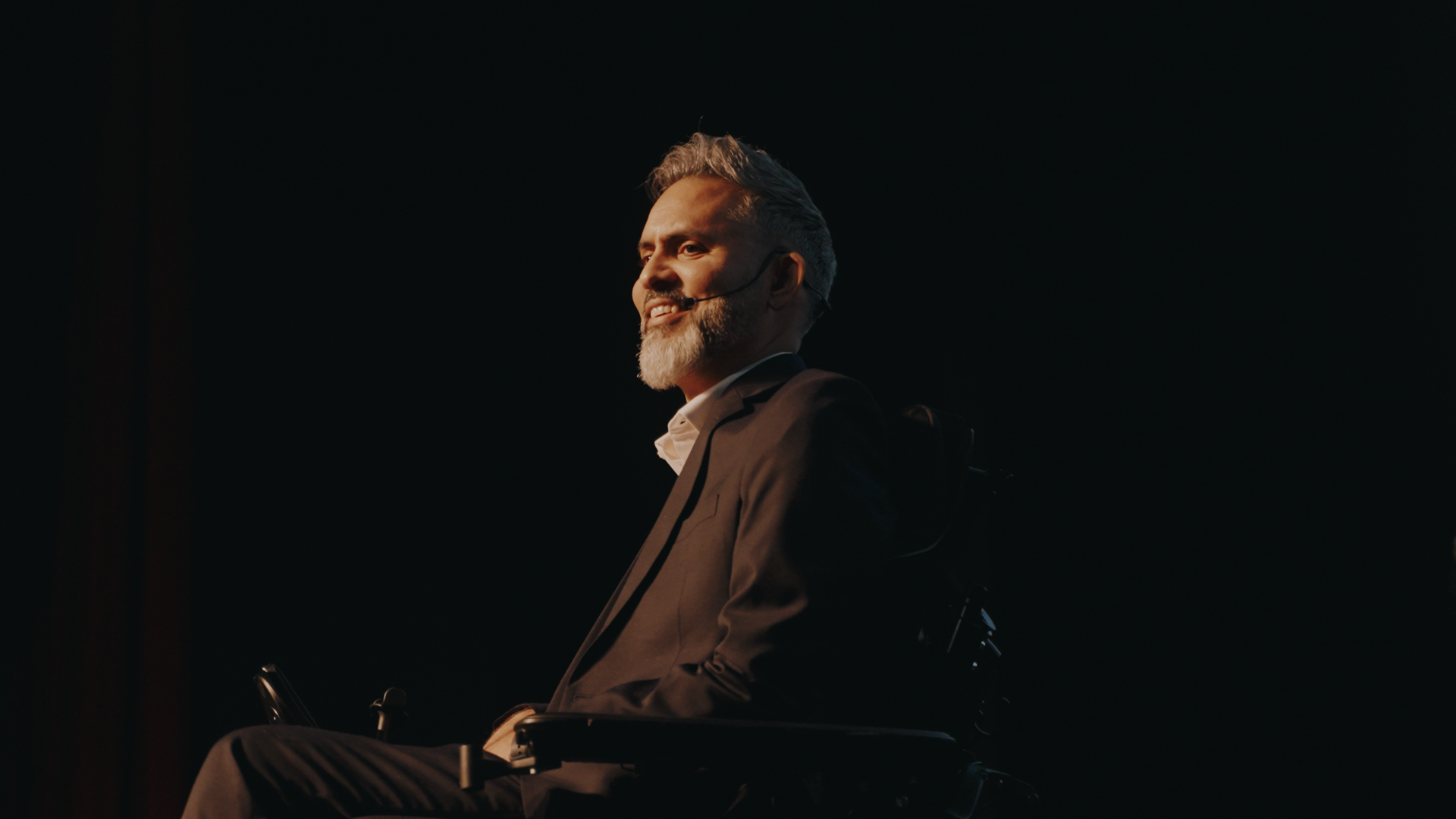
At the beginning of a keynote, people see what is immediately visible. A wheelchair. A narrative that feels familiar before a single word is spoken. But as the story unfolds, something changes. What people respond to is not inspiration in the abstract. It is recognition. The realization that what they thought they understood at first glance was incomplete.
Not because the facts changed.
But because the story widened.
That shift feels immediate to the audience.
Living it was different.
It began much earlier, more than two decades ago, with a rare muscle condition that forced me to adapt long before I had language for what I was doing. Day by day, I learned how to work around limitations and keep going, even when the future felt uncertain.
For a long time, adapting was simply part of daily life. It was not something I framed as resilience or strength. It was just what was required. Plans shifted. Approaches adjusted. Progress came through consistency rather than certainty.
Only much later did I understand how formative that experience had been.
Perspective under pressure
Like so many organizations, the first months of the pandemic collapsed certainty overnight. Revenue disappeared. Operations shut down. Long-range plans became obsolete almost instantly. The only thing everyone knew was that the old playbooks no longer applied.
As the leader responsible for financial planning, my role was not simply to react. It was to help the organization see a path forward when no clear one existed. That meant building scenarios in real time. Revising budgets repeatedly. Communicating uncomfortable truths clearly and calmly. Sitting in rooms with senior leaders, not to predict the future, because none of us could, but to decide how we would navigate it together.
What mattered most in those moments was not just technical skill. It was perspective.
The ability to stay steady under pressure. To hold multiple possible outcomes at once. To lead with clarity even when certainty was unavailable.
What I did not fully appreciate at the time was how much my own lived experience had prepared me for that environment.
Years of adapting had quietly built a different kind of resilience. Navigating change was not new. Staying calm when the ground shifts was not theoretical. It was practiced.
That perspective did not replace the experience of others around the table, many of whom had navigated crises of their own. It complemented it. Different paths, different challenges, shared responsibility. Together, those varied experiences became a strength.
When stories widen
The conversations after keynotes often follow a similar pattern. Many come from parents of children with visible challenges who connect the change I speak about on stage to the change shaping their own lives.
They describe how fully their lives have become oriented around managing what is directly in front of them: Appointments. Systems. Barriers. Logistics. In that constant effort, they admit they have stopped imagining what might come next.
Not because they lack belief or love.
But because the system surrounding them makes it hard to picture anything else.
What stays with me most is when they say this was the first time they were able to see their child beyond the immediate challenge. To imagine a full life. Contribution. A future defined by more than what needs managing.
That moment is not about me.
It is about what happens when perspective shifts, when the story widens just enough to allow possibility back in.
What we miss when we don’t see beyond
When I roll into a room, part of my story is immediately visible. Before I speak, before I contribute, before I demonstrate anything I am capable of, a narrative has already begun. Not out of malice, but out of habit.
What is less obvious is how often the same thing happens when nothing is visible at all.
Most people carry challenges that never announce themselves. Pressure to provide. Fear of failure. Health concerns. Caring responsibilities. Doubt about whether they truly belong. None of it appears on a résumé. None of it shows up in a meeting invite.
And yet, those unseen stories shape how people show up just as much as the visible ones do.
The difference is simple. When a challenge is visible, it risks becoming the headline. When it is invisible, it is often ignored, even though the weight is just as real to the person carrying it.
Seeing beyond is not about focusing on difference. It is about resisting the urge to let any single detail, visible or not, define the whole person.
Where opportunity is quietly shaped
In professional settings, assumptions tend to form early. Sometimes they are subtle. Sometimes they are well intentioned. But once they settle in, they quietly shape opportunity. Who is trusted. Who is stretched. Who is invited into the room when decisions are being made.
Seeing beyond is the deliberate choice to interrupt that instinct early.
Not to lower the bar.
But to sharpen it.
Looking back, what I am most aware of is this: I delivered results because I was given the opportunity to do so.
The value I was able to contribute did not come from being helped. It came from being trusted.
At key moments, people chose not to let assumptions stand in for understanding. They did not rush to conclusions about what I could or could not do. They asked. They listened. They focused on capability instead of constraint.
That choice mattered.
Because when we see beyond surface narratives, we do not offer charity. We unlock contribution.
And when enough of us do that, we are not just changing one person’s path.
We are reshaping the story we all share.
Rayhan Azmat is a vice president and senior finance executive at a public company, and a keynote speaker focused on leadership, resilience, and navigating change.
Leave a Reply